Cyclone devastation in Chozha Nadu
Ponniyin SelvanCyclone devastation in Chozha Nadu transforms a delayed monsoon into a sudden humanitarian and political emergency. The storm breaks with startling force across a landscape already strained by dwindling rivers and wilting crops; it damages trees and threatens people on the roads, while reports of submerged coastal towns raise the prospect of destruction on a far greater scale. The response exposes the difficulty of governing amid incomplete information, scarce resources, and public distrust.
Conditions Before the Storm
The monsoon has not arrived when expected. On two occasions, rain seems imminent, only for the skies to clear again. Meanwhile, the Kaveri River and its tributaries run noticeably lower, and newly planted saplings wilt under the scorching sun. This prolonged uncertainty gives the storm’s eventual arrival a double force: it brings the rain the fields have been waiting for, but does so with a violence that turns relief into peril.
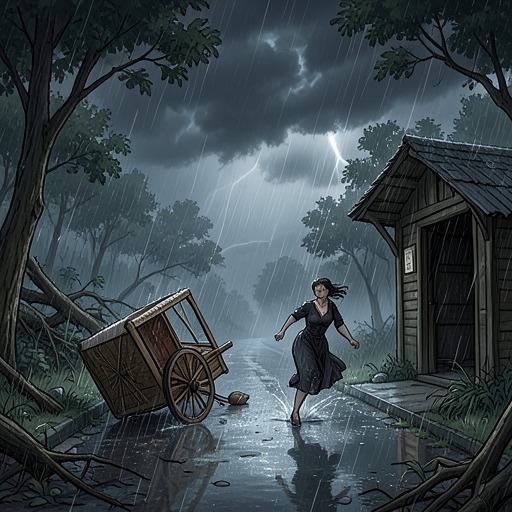
The change begins abruptly. Dark clouds gather on the northeastern horizon and crowd across the sky; a sharp wind follows, then rain that swells from drizzle to a thunderous downpour in less than a quarter of a naazhigai. The storm does not arrive as a gradual easing of drought. It overwhelms the landscape almost at once, making the transition from exposed, drying fields to dangerous weather as sudden as it is consequential.
Destruction on the Roads
Wind and rain break branches from roadside trees and send them crashing down. Birds flee their damaged nests in every direction, while travelers scatter: some run from the rain, others from the falling boughs. Thunder adds to the panic, its roar making the storm seem to have opened across the whole sky. The scene presents the weather not simply as scenery but as an immediate force that disrupts movement and puts lives at risk.
A lightning flash reveals the damage at a wayside shelter. A vast banyan tree opposite the pavilion has been nearly uprooted, its roots raised and its branches and aerial shoots broken and crushed. Two horses and five or six men are trapped beneath the wreckage. Rescuers already surround the fallen tree, urgently pulling at the branches in an effort to free them. The episode gives the storm a concrete human scale: a single collapse has turned an ordinary roadside passage into a rescue operation, with people and animals pinned beneath the remains of a tree that had stood beside the road.
Relief and Uncertain Reports
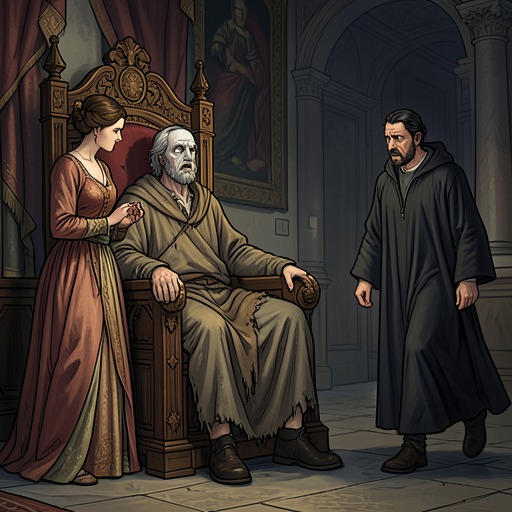
By dawn, the storm’s consequences have become a matter of royal responsibility. Kundhavai Devi tells Aniruddha Brahmaraayar that Sundara Chozha’s physical health is much the same, but that the storm has deeply disturbed him. He has scarcely slept and is grieving for poor people forced to endure the rain and deprivation in flimsy huts. He has sent his daughter as an envoy to arrange whatever aid can be offered to those whose lives have been ravaged.
The exchange also shows how little is yet known. Aniruddha Brahmaraayar says that reports of the extent of damage have not arrived, and that even the resources available to him are constrained: Periya Pazhuvettarayar is away and has locked his treasure vault. A disciple brings alarming news that the sea has surged inland and submerged towns from Kodikkarai to Naagapattinam. Aniruddha Brahmaraayar does not present this as confirmed fact. He warns that rumors travel faster than storms and points out that official messages from the coast cannot yet have arrived; messengers are expected only later in the day. Until then, the scale of the emergency remains uncertain even as the need to help is plain.
Public Anger and Political Consequences
That uncertainty matters in a kingdom already close to political rupture. Aniruddha Brahmaraayar describes Chozha Nadu as seething: people believe Sundara Chozha is imprisoned in his own castle, and they blame the Pazhuvettarayars for sending ships to arrest Arulmozhi Varman and for arranging his supposed drowning. He fears that news of Arulmozhi Varman’s presence in the country could bring people into open rebellion and a movement to crown him immediately. Meanwhile, the Pazhuvettarayar forces are poised for war, and Kodumbalur Periya Velaan is marching toward Thanjavur with an army.
The storm does not settle these rival claims or cause the succession dispute, but it intensifies the conditions in which they unfold. Its visible destruction heightens concern for ordinary people; its possible coastal reach remains a frightening rumor; and the emperor’s response makes relief part of the court’s urgent business. In a realm where suspicion about royal confinement and a prince’s fate is already inflaming the public, the cyclone adds another crisis that demands credible information and action. The disaster’s significance therefore lies both in what the wind and rain destroy and in how their sudden arrival tests a strained kingdom’s capacity to respond.